Middle East Shipping Disruption: How Food-Service Brands Can Protect Supply Chain Continuity
Mar 11, 2026
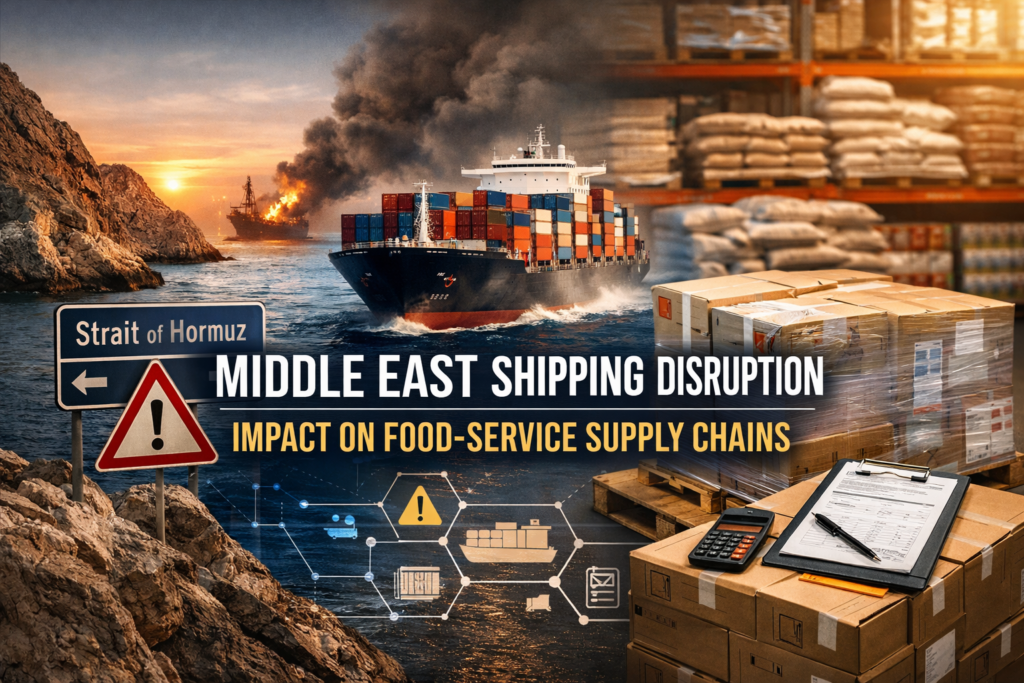
Global shipping disruptions do more than slow cargo. They create uncertainty, raise costs, and put operational continuity at risk.
If you source, ship, or distribute goods internationally, you are likely already feeling the effects of the current disruption affecting trade routes tied to the Middle East. The situation remains fluid, and there are no simple solutions.
That is exactly why the most important question is not just what to do next. It is who you can trust to act in your best interest when the pressure is on.
For more than 40 years, Intria has helped customers navigate complex supply chain challenges. Our expertise, relationships, and responsiveness give food-service operators access to the information they need to make critical decisions and the support they need to keep moving during times of crisis.
When supply chains are under pressure, the difference is having a partner who knows your business, understands your needs, and moves quickly, not a large faceless company that treats you like just another account.
What’s Happening in Global Shipping Right Now
The current disruption is affecting some of the world’s most important trade corridors.
Commercial shipping through the Strait of Hormuz and the Red Sea has been suspended, while several of the world’s largest carriers have paused operations across the region. Middle Eastern airspace closures have also added pressure to air freight. As a result, cargo is being rerouted, delayed, and in some cases stranded.
For food-service brands, this is not just a logistics issue. It is a business continuity issue.
Intria has become the partner food-service brands call when the supply chain breaks because we do more than move products. We solve problems, and we are built to move fast.
Why This Shipping Disruption Matters
The Strait of Hormuz is one of the world’s most critical shipping chokepoints. With commercial traffic affected and major carriers suspending crossings, the impact stretches far beyond one lane or one region.
At the same time, renewed disruption in the Red Sea and Bab el-Mandeb Strait has pushed carriers to reroute around the Cape of Good Hope, adding significant transit time. Regional airspace restrictions are also affecting cargo that would normally move by air.
The result is a simultaneous disruption across ocean and air routes that many global supply chains depend on.
This is not the first major disruption customers have had to navigate. From port congestion during and after COVID to Red Sea reroutings and Suez Canal disruptions, resilient food-service companies have consistently shared one thing in common: they had a proactive supply chain partner who moved before they were asked.
That is what Intria is doing now.
Why Food-Service Supply Chains Are Especially Vulnerable
Not every industry feels disruption in the same way. Food-service operators face a unique set of risks because product availability, compliance, and timing all directly affect operations.
1. Product-specific operations limit flexibility
Food-service businesses often cannot substitute products easily.
Franchise systems need consistency across locations. Hotel kitchens must maintain standards for guests. Caterers and institutional operators cannot promise products they may not be able to source. In this environment, disruption to a single SKU can create consequences far beyond the cost of the item itself.
2. Rerouted cargo can trigger documentation delays
When cargo arrives through a different port or route than originally planned, customs documentation, health certificates, import permits, and regulatory labeling may need to be revised.
For food products under FDA, USDA, or similar oversight, even a small documentation mismatch can result in cargo holds, inspection delays, or rejection at the border.
3. Costs can become volatile quickly
Freight costs can rise fast during disruption.
Spot container rates, fuel surcharges, and war-risk premiums can create unplanned increases that squeeze already tight margins. For food-service operators, higher logistics costs can directly affect profitability.
Understanding these risks is important, but understanding alone is not enough. What matters is having the experience, industry knowledge, and commitment to work closely with customers to find practical solutions under difficult conditions.
How Intria Helps Keep Clients Moving
Responsiveness starts with understanding each customer’s unique requirements.
Intria works closely with procurement and logistics partners and relies on strong professional relationships across the supply chain to help make timely delivery possible, even in challenging conditions.
Here is how we support clients during disruption:
Real-time shipment visibility and proactive alerts
We do not wait for customers to call and ask where their cargo is.
Our team continuously tracks active shipments against affected routes and carriers, providing updates and revised ETAs as conditions change. If cargo is diverted, delayed, or exposed to new risk, clients hear it from us as soon as we know, along with available options.
Fast resolution of documentation and compliance issues
Unexpected disruptions often create paperwork problems.
We are built to respond quickly, from labeling and permits to revised documentation needed for customs clearance. That agility helps reduce avoidable delays and supports smoother movement through ports and regulatory checkpoints.
Alternative sourcing and purchasing options
When supply routes are disrupted, flexibility matters.
If temporary workarounds are possible, we work to identify them. Our sourcing experience and relationships can help uncover options that may provide relief when standard supply channels are under pressure.
Insurance and cost management guidance
Not every disruption can be predicted, but strong planning reduces exposure.
We work closely with clients to support contingency planning and help ensure the right insurance and risk-management measures are in place before a crisis escalates.
What Food-Service Brands Should Do Now
During a shipping disruption, waiting usually makes the problem worse.
Food-service operators should be reviewing at-risk shipments, pressure-testing inventory exposure, checking documentation readiness, and evaluating alternative sourcing paths now, not after delays begin to compound.
This is where the right supply chain partner makes a measurable difference.
A responsive partner helps you act earlier, communicate faster, and make better decisions under pressure.
Looking Ahead: Volatility Is the New Operating Reality
There is no way to know exactly how long the current disruption will last or what its full residual impact will be.
What we do know is that businesses now operate in an environment defined by volatility, uncertainty, complexity, and ambiguity. That is why your choice of partner matters more than ever.
Intria has proven itself to be a reliable resource for leading brands and a growth partner for emerging companies preparing for what comes next.
Because when you need to get moving, we move with you.
Need Help Navigating the Current Shipping Disruption?
If your supply chain is being affected by disruptions in the Middle East, our team is ready to discuss your situation, review your options, and help you take the next step.
For immediate assistance, call: (+1) 845-460-0156
This advisory reflects conditions as of March 5, 2026 and is based on available information from carrier advisories, industry analysts, and port authorities. The situation is evolving rapidly.
Frequently Asked Questions
It is causing shipment delays, cargo rerouting, added transit time, documentation complications, and rising freight-related costs. For food-service businesses, these disruptions can quickly affect product availability and operating continuity.
Food-service operators often rely on highly specific products, ingredients, packaging, and compliance documentation. That makes substitution harder and increases the operational impact of delayed or diverted shipments.
They should review at-risk shipments, assess inventory exposure, confirm documentation readiness, evaluate alternative sourcing options, and work closely with a responsive logistics partner.
A change in route or port can require updates to customs documentation, health certificates, permits, and labeling. If those documents do not match the new shipping reality, cargo may be delayed or rejected.
They should look for responsiveness, proactive communication, shipment visibility, documentation agility, sourcing support, and strong relationships across the supply chain.
Take compliance off your plate
We’ll handle the details—accurately, efficiently, and on time